что ты ищешь?
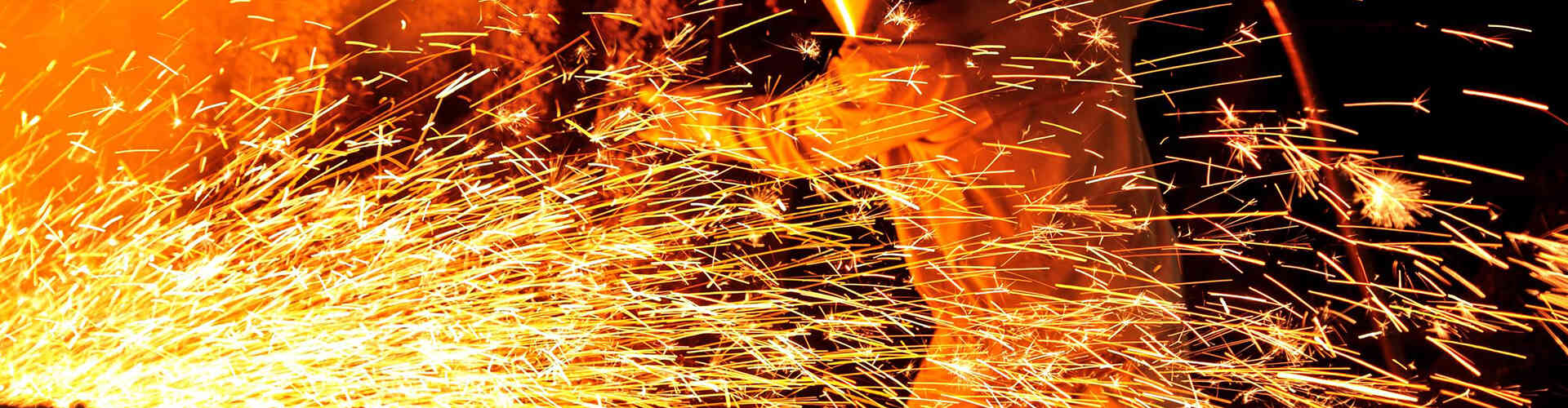
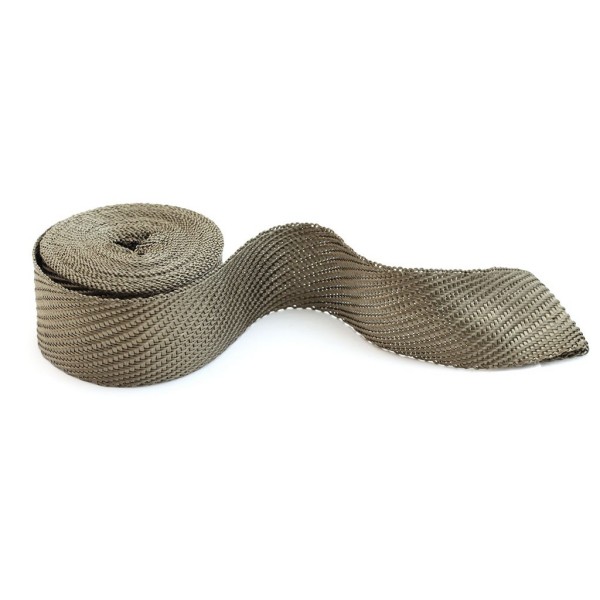
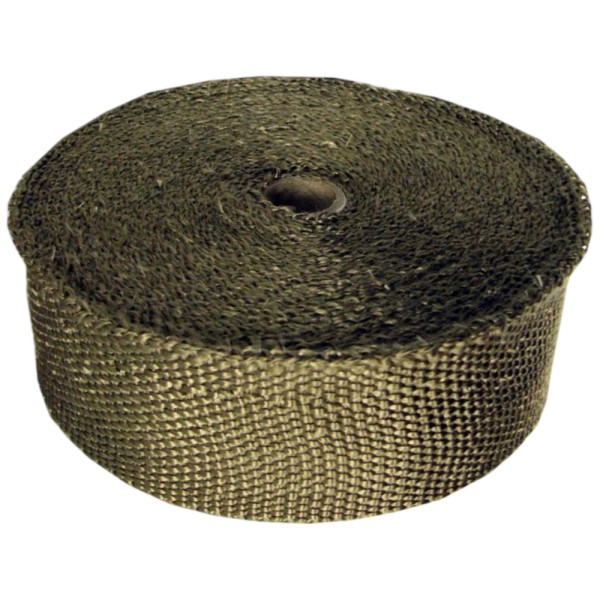
Titanium exhaust wrap is widely used on performance headers, turbo downpipes, motorcycle exhaust pipes and other high-temperature exhaust components where conventional thermal protection may not provide the required durability.
Despite the name, most titanium exhaust wrap does not contain metallic titanium. The term is commonly used in the exhaust insulation industry for a woven basalt-fiber material produced from volcanic rock.
BSTFLEX manufactures Black Titanium Exhaust Pipe Wrap for high-temperature exhaust thermal management and supplies different widths and roll lengths for automotive, motorcycle, racing and industrial applications.
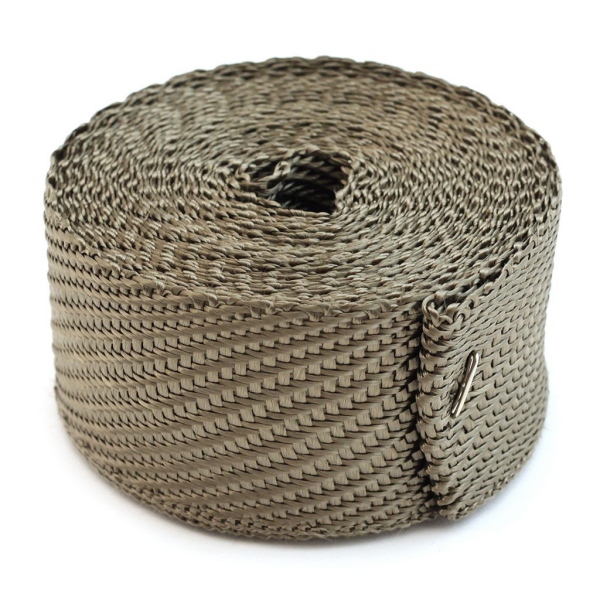
The primary material is basalt fiber.
Basalt fiber is produced from natural volcanic rock. The rock is melted at high temperature and processed into continuous fibers, which can then be woven into a flexible thermal insulation tape.
This gives titanium-style exhaust wrap a different material structure from conventional fiberglass wrap.
Common search terms for this product include:
titanium exhaust wrap
titanium heat wrap
titanium header wrap
basalt exhaust wrap
lava rock exhaust wrap
volcanic rock exhaust wrap
These names often refer to the same general material family rather than completely different products.
The BSTFLEX Black Titanium Exhaust Pipe Wrap is manufactured from volcanic-rock-derived fiber and designed specifically for direct installation around exhaust components.
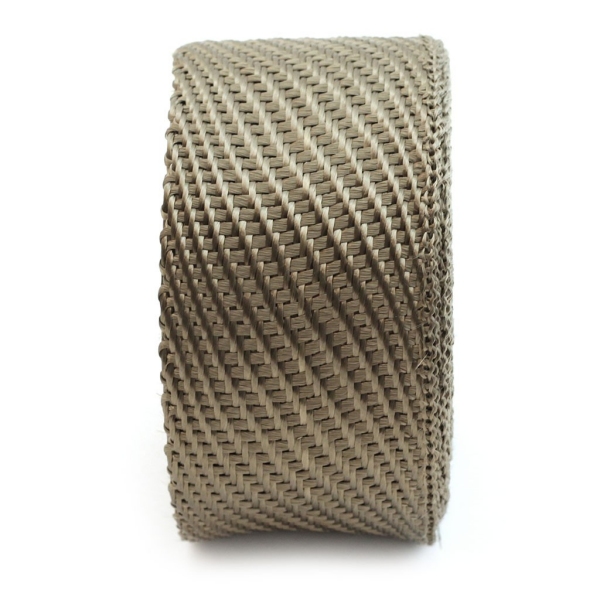
The word “titanium” describes the commercial appearance and performance category rather than the fiber chemistry.
Basalt wrap typically has a brown, bronze or dark metallic-looking woven surface that resembles the appearance commonly associated with titanium exhaust components.
For technical specifications, however, the more accurate material description is:
Basalt fiber exhaust wrap
This distinction matters for engineers and buyers because a titanium-colored wrap and an actual titanium metal exhaust component are completely different materials.
It is also important not to confuse titanium exhaust wrap with wrapping a titanium exhaust pipe.
Some exhaust-wrap manufacturers specifically advise against wrapping thin-wall titanium exhaust systems because excessive retained heat may affect the metal's durability. The substrate material should therefore always be considered before insulation is specified.
Temperature rating is one of the main reasons buyers consider basalt-based exhaust wrap.
BSTFLEX specifies its Black Titanium Exhaust Pipe Wrap for direct heat exposure up to approximately 1800°F, with higher short-duration exposure capability depending on operating conditions and installation.
This places basalt wrap above many general-purpose fiberglass products for severe exhaust applications.
However, temperature selection should never rely on a single maximum number.
Engineers should distinguish between:
continuous surface temperature;
short-duration peak temperature;
exhaust gas temperature;
radiant temperature;
distance from the heat source;
airflow around the pipe;
duration of each heat cycle.
A wrap rated for a high intermittent temperature may not necessarily be suitable for continuous operation at the same value.
For applications operating beyond the practical range of basalt fiber, BSTFLEX also offers High Temperature Inferno Header Exhaust Heat Wrap manufactured from high-silica textile material.
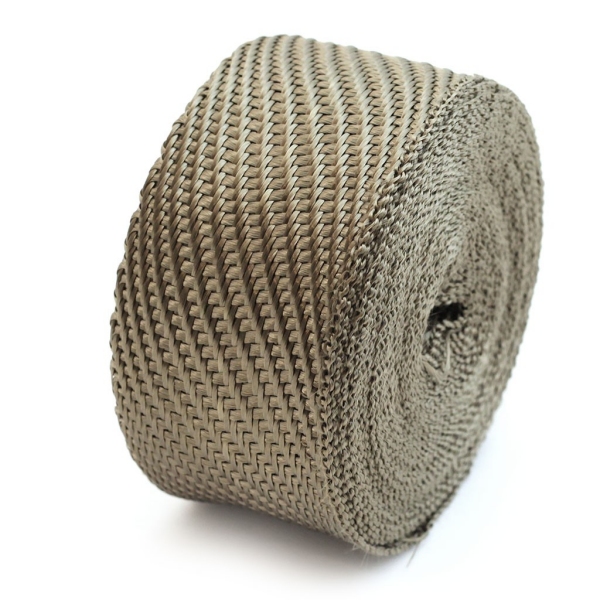
Both materials are used for exhaust insulation, but they serve slightly different operating requirements.
| Property | Titanium / Basalt Exhaust Wrap | Fiberglass Exhaust Wrap |
|---|---|---|
| Base fiber | Basalt / volcanic rock | Glass fiber |
| Typical market position | Performance / higher-temperature | General-purpose |
| Flexibility | Good | Good |
| Thermal cycling resistance | Very good | Good |
| Appearance | Brown, bronze, black | White, tan, black |
| Typical use | Headers, turbo downpipes, racing, motorcycles | Headers, pipes, motorcycles, general exhaust |
| Cost | Usually higher | Usually lower |
Fiberglass remains an economical choice for many exhaust systems.
Basalt-based wrap becomes more attractive when the application involves:
higher sustained temperatures;
frequent thermal cycling;
performance engines;
turbocharged exhaust systems;
greater durability requirements.
This does not mean basalt is automatically the correct material for every exhaust.
Material selection should be based on actual operating conditions.
Headers are one of the most common applications.
The primary tubes are often located close to wiring, ignition components, hoses and body panels.
A flexible titanium header wrap can follow individual tubes and collectors while reducing radiant heat into the surrounding engine compartment.
For complicated tubular headers, narrower wrap is generally easier to install around bends and junctions.
Fabricated tubular manifolds can produce concentrated radiant heat close to sensitive components.
Basalt exhaust wrap can be used where the geometry allows spiral wrapping.
Very compact or irregular manifolds may instead benefit from a shaped removable blanket.
Turbocharger downpipes experience high exhaust temperatures and are frequently positioned close to:
firewall panels;
brake lines;
wiring;
intake systems;
transmission components;
plastic or rubber components.
This makes titanium exhaust heat wrap particularly relevant to turbocharged vehicles.
For higher-temperature turbo systems, engineers should compare basalt wrap with silica wrap before choosing the insulation.
Motorcycles are another major application for titanium exhaust wrap.
The exhaust system is exposed and often runs close to:
the rider's leg;
fairings;
wiring;
engine components.
Basalt wrap is popular in motorcycle applications because it combines a distinctive appearance with practical heat insulation.
Common related searches include:
motorcycle titanium exhaust wrap
titanium motorcycle header wrap
motorcycle exhaust heat wrap
1 inch titanium exhaust wrap
2 inch titanium exhaust wrap
Racing vehicles frequently operate under higher thermal loads than standard road vehicles.
Exhaust wrap can help manage heat around:
tubular headers;
turbo manifolds;
downpipes;
exhaust collectors;
compact engine bays.
In these applications, thermal cycling resistance becomes particularly important because the exhaust system repeatedly moves between ambient and extreme operating temperatures.
Titanium-style basalt wrap is not limited to passenger vehicles.
It may also be used around:
diesel engine exhaust pipes;
generator exhaust systems;
industrial exhaust tubing;
equipment exhaust lines.
For larger-diameter industrial pipes, however, wider wraps, lagging systems or removable blankets may provide faster installation and easier maintenance.
BSTFLEX offers a broader range of Exhaust and Header Heat Wrap materials for these different operating environments.
Width affects installation more than many buyers expect.
A narrower wrap is useful for:
small-diameter headers;
tight bends;
motorcycle pipes;
complex manifold geometry;
closely spaced primary tubes.
It takes longer to install but conforms more easily to complicated shapes.
A wider wrap is usually preferred for:
larger exhaust pipes;
downpipes;
straight tubing;
long pipe sections;
faster production installation.
Current market products commonly use 1-inch and 2-inch formats because they cover most automotive and motorcycle applications.
For OEM projects, BSTFLEX can supply custom widths and roll lengths according to pipe diameter, production method and packaging requirements.
Required roll length depends primarily on:
exhaust pipe outside diameter;
total pipe length;
wrap width;
installation overlap;
number of bends;
collectors and junctions.
A long straight pipe consumes less material than a complex header with multiple primary tubes of the same overall length.
For repetitive OEM production, the most reliable approach is to calculate consumption from an actual exhaust drawing or sample.
This allows the required roll length to be matched to each finished assembly and reduces material waste.
A typical basalt exhaust wrap installation uses an overlapping spiral pattern.
The installation should maintain consistent tension and overlap throughout the exhaust component.
Stainless-steel locking ties or clamps are commonly used to secure the starting and finishing points.
Particular attention should be paid around:
welds;
flanges;
oxygen sensors;
mounting brackets;
flex joints;
collector transitions.
Do not wrap over a structural exhaust defect.
Cracks, corrosion and leaking welds should be repaired before thermal insulation is installed.
Some installers lightly dampen exhaust wrap before installation because moisture can temporarily make the woven tape easier to conform around complicated pipe shapes.
Whether this is necessary depends on the particular product construction.
The correct approach is to follow the installation instructions for the specific exhaust wrap being used rather than assuming all materials require wet installation.
The main purpose of exhaust wrap is to reduce heat transfer from the hot exhaust pipe toward its surroundings.
By placing an insulation layer directly against the pipe, radiant and convective heat transfer into the engine compartment can be reduced.
This can be useful when exhaust components run close to:
electrical wiring;
hoses;
intake ducts;
sensors;
fuel lines;
body panels.
The actual temperature reduction depends on the exhaust temperature, insulation thickness, wrap installation, airflow and surrounding geometry.
Claims of a fixed percentage reduction should therefore be treated cautiously unless they are supported by a controlled test matching the actual application.
Exhaust insulation retains more thermal energy inside the pipe.
Hotter exhaust gas has different density and flow characteristics than cooler gas, which is one reason exhaust insulation is commonly used in motorsport and turbocharged systems.
However, the primary engineering reason to specify exhaust wrap should be thermal management.
Performance gains depend on the complete engine and exhaust system and should not be guaranteed solely from installing wrap.
The answer depends heavily on the pipe material and operating environment.
Exhaust wrap can retain moisture against the pipe surface if the system is repeatedly exposed to water, road spray or condensation.
Potential risk is greater with corrosion-prone substrates than with suitable stainless-steel exhaust systems.
Before wrapping, consider:
pipe alloy;
existing corrosion;
road salt exposure;
marine exposure;
water drainage;
heat cycles;
maintenance frequency.
The pipe should always be in sound condition before installation.
Basalt wrap is versatile, but there are situations where another thermal protection method may be better.
Consider a removable insulation blanket when:
the exhaust component requires frequent maintenance;
the geometry is too irregular for spiral wrapping;
rapid removal is important.
Consider a metal heat shield when:
direct contact insulation is undesirable;
an air gap can be maintained;
heat must be blocked in one specific direction.
Consider silica wrap when:
operating temperatures exceed the practical capability of basalt.
The broader Exhaust Wrap Complete Guide explains how these different exhaust insulation methods fit into a complete thermal management system.
For manufacturers and distributors, specification involves more than choosing a roll from a standard catalog.
BSTFLEX can support projects requiring:
custom wrap widths;
different roll lengths;
black or natural basalt constructions;
stainless-steel fixing ties;
private-label packaging;
bulk rolls;
retail kits;
OEM packaging;
application-specific development.
Typical customers include exhaust manufacturers, motorcycle accessory brands, automotive aftermarket suppliers, industrial equipment manufacturers and thermal-management distributors.
For projects requiring basalt, fiberglass, silica or composite exhaust insulation, explore the complete BSTFLEX Exhaust and Header Heat Wrap range.
Generally, no. Most products sold as titanium exhaust wrap are manufactured from basalt or volcanic-rock-derived fiber. “Titanium” is primarily a commercial product name.
In many automotive aftermarket applications, the terms refer to the same general material family. Always check the actual fiber composition in the technical specification.
Common applications include exhaust headers, turbo downpipes, tubular manifolds, motorcycle exhaust pipes, racing exhaust systems and high-temperature engine exhaust lines.
Basalt-based titanium-style wrap generally offers higher thermal durability and good resistance to repeated heat cycling, while fiberglass is often more economical. The correct choice depends on temperature, environment and budget.
One-inch wrap is useful around tight bends and small headers. Two-inch wrap is generally faster to install around larger or straighter exhaust pipes.
Do not assume that it can. Thin-wall titanium exhaust components may require different thermal-management methods because excessive retained heat can affect the metal. Check the exhaust-system manufacturer's requirements before wrapping.
теги :

No.10, Chuangxin North Road, Nanshan Park, Ningguo Economic and Technological Development Zone, Ningguo City, Anhui Province, China
тел/Whatsapp : 0086-15856303740
Эл. адрес : sales@bstbraidedsleeve.com
Skype : vanesa-cheng